Why Most CRM Rollouts Stall After Go-Live (And What Actually Fixes It)
Every CRM project starts with a business case built on adoption: more visibility into pipeline, cleaner data, faster reporting, a single source of truth the whole org can trust.
Then go-live happens and the business case quietly stops being about adoption and starts being about survival. IT declares the project complete, the org moves on to the next initiative, and the system sits there, technically live, functionally half-used, while the ROI everyone signed off on slips further out of reach.
This isn't a Salesforce problem or a tooling problem at all. It's a sequencing problem. Most organizations treat technical rollout as the finish line, when it's really the starting line.
The gap nobody budgets for
Implementation partners are excellent at what they're hired to do: configure the platform, migrate the data, get the environment production-ready. That's real, difficult work, and it's the foundation everything else depends on.
But a configured system and an adopted system are two different outcomes, and the distance between them is where most CRM investments quietly lose their value. Users revert to spreadsheets and side channels because nobody showed them why the new way is better, not just different. Managers can't coach a workflow they were never trained to reinforce. Six months in, the system holds a fraction of the data it was designed to capture, and the “CRM problem” gets blamed on the software instead of the transition.
We've watched this play out at scale. In one recent engagement, a recruiting organization needed to bring roughly 2,000 users up to speed across a fragmented CRM, ATS, and shared-services environment, not as a one-time training event, but as a phased enablement strategy built alongside their internal L&D team. eLearning and quick reference guides handled day-one competency. A technical certification track prepared their own people to sustain the system long after the rollout team left.
The platform didn't change, the outcome did.
The stakes just went up
That gap between “configured” and “adopted” was already expensive when a CRM was just a system of record. It gets a lot more expensive now that the CRM is becoming a coworker.
With Dreamforce back in San Francisco this month, the headline story again is AI: specifically Claudeforce, the newly expanded partnership between Salesforce and Anthropic that puts Claude's reasoning inside Agentforce as the default model for Agent Builder and Agentforce Coworker, and puts live Salesforce data inside Claude itself. That's a meaningful shift. Reps and service teams are no longer just clicking through fields and flows; they're expected to delegate real work to an agent, trust its output, and know when to step in.
Every wave of Salesforce capability has made the platform more powerful and, without deliberate change enablement, more likely to underdeliver. Agentic AI raises that bar further… it's not enough to show someone which button opens which record anymore, people need to understand what an agent can be trusted to do on its own, how to review its work, and when human judgment still has to take the wheel. That's a change management problem before it's a technology problem, and it's exactly the layer that gets skipped when “rollout” and “adoption” get treated as the same milestone.
Adoption is a discipline, not an event
The organizations that get this right treat change enablement as its own workstream, with its own timeline, budget, and owner, running in parallel with the technical build rather than bolted on after it. A few things tend to separate them from the ones still fighting adoption a year later:
Change management runs alongside the technical build, not after it. Stakeholder alignment, communication planning, and manager readiness start on day one of the project, so the system launches into an organization that already understands why it's changing.
Paired with change management, training is an indispensable activity within this workflow, and one that comes with its own set of process and discovery. One size fits all should never be the approach, and it’s a particular area that AI cannot replicate – personas and learning styles need to be considered, as well as the needs of the organization, with the human expertise and understanding that make true adoption a reality.
Apogee’s best practice workflow supports exactly this workstream:
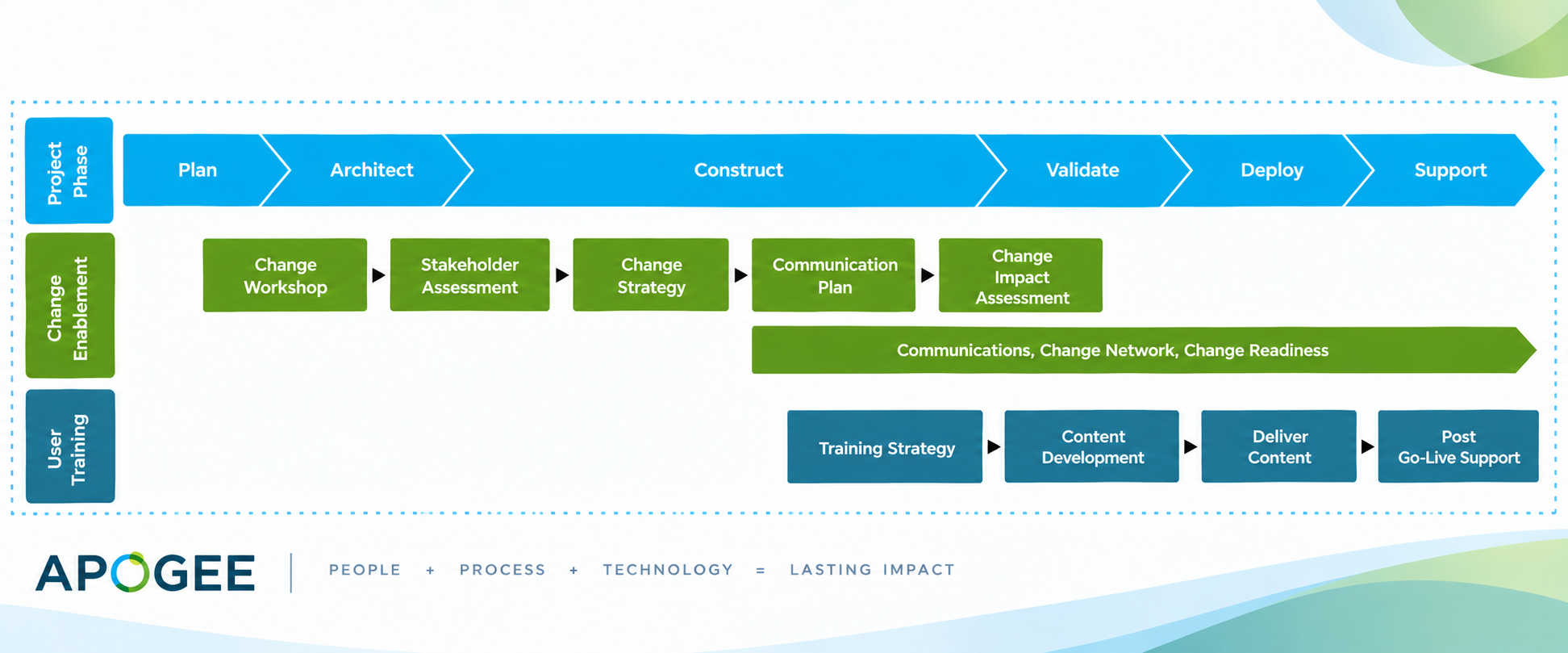
Example Change Enablement and User Training alignment to the overall implementation phases.
Someone owns adoption the way someone owns the migration. Technical rollout has a project manager. Adoption deserves the same rigor, the same milestones, and the same accountability, not a “figure it out” handoff to whichever internal team has bandwidth.
The investment is already made. Protect it.
By the time a CRM or ATS platform goes live, and now, by the time an AI agent goes live inside it, the organization has already spent the budget, the political capital, and the months of planning it takes to get there. The people side of change is what determines whether that investment compounds or quietly erodes.
Thirty years in, that's the whole thesis: the technology is the foundation, but adoption is what protects it. Not best-in-class jargon, not a bolt-on training module. Just the discipline of making sure the humans on the other side of the login screen, and now the humans working alongside an agent, actually use what was built for them.
Apogee Change Enablement Solutions partners with organizations across up to 13 Salesforce clouds and ATS platforms to turn CRM investments into adopted, sustained systems. Learn more at apogeecrmsolutions.com.